


The Japanese Apartment Layout Guide: Finding a Perfect Place

Millions of people live in apartments in Japan. You might expect apartment hunting in Japan to be simple.
Cultural differences, apartment types, and specific vocabulary make it harder than you'd expect. Many renters struggle to keep track of every term.
This Japanese apartment layout guide breaks down the most common layouts you will see. You will learn apartment sizes, features, and apartment layout terms for each type.
What do Japanese apartment abbreviations mean?
Japanese apartment layout terms use 5 common abbreviations: R, L, D, K, and S. Most Japanese apartments combine two or more of these letters.
Here is what each letter stands for:
R = Room
L = Living room
D = Dining area
K = Kitchen
S = Storage room
You rarely see S written out. Instead, look for 収納 on the floor plan, which means storage space.
The number before these letters shows the number of rooms. A 1DK has one room plus a dining area and kitchen. A 2LDK has two rooms, plus a living room, dining area, and kitchen.
Keep reading to learn the size and features of each apartment layout below.
Japanese apartment types
Here are some typical apartment floor plans in Japan that you will see.
1R
1R stands for one room. Essentially, it is a one-room studio apartment.
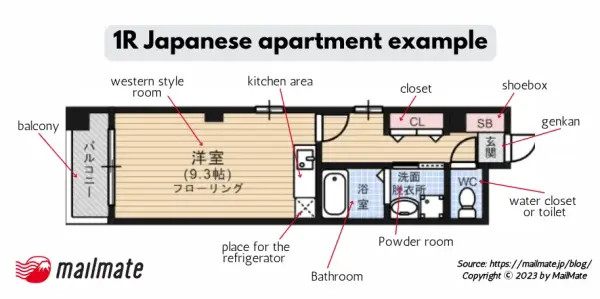
Common 1R Japanese floor plan layout
A 1R is the smallest apartment layout you can rent. It usually has a small kitchen area with one burner, a small counter, a mini fridge, and closet space.
Most 1R apartments have a 3-point unit bath. This is one small room with a toilet, sink, and bathtub combined. The exact space for each item depends on the apartment size.
In a 1R, you sleep, cook, eat, clean, and do laundry in one room.
Summary:
Similar to a studio apartment
Floor space: 12 to 20 square meters
Price range in central Tokyo: ¥60,000-¥100,000
1K
K stands for kitchen. A 1K apartment has one room and a separate kitchen area.
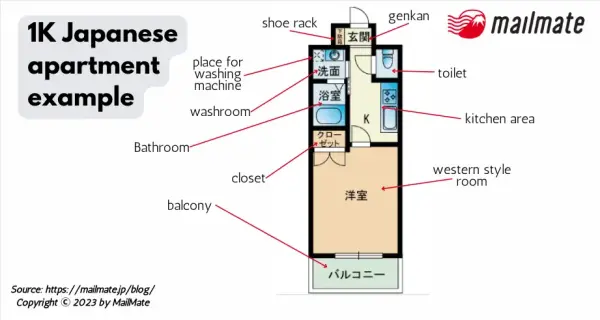
Common 1K Japanese floor plan
A 1K looks similar to a 1R, but the kitchen space is separated from the main room. A 1K kitchen area is usually bigger than a 1R kitchen.
Each 1K apartment varies. Some have closet space, some don't. Some have a unit bath, others have a separate bathroom and toilet.
A 2K apartment has two rooms and one kitchen area. Picture a large 1K apartment split by a wall into two rooms.
Summary:
One room with a separate kitchen area
Floor space: 20 to 25 square meters
Price range in central Tokyo: ¥70,000-¥150,000
1DK
D stands for dining, and K stands for kitchen. A 1DK apartment has one room, a dining area, and a kitchen area.
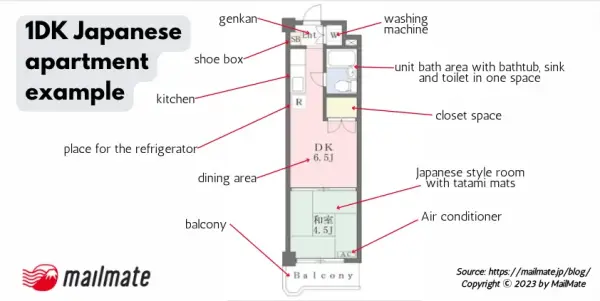
Common 1DK Japanese floor plan
The kitchen area is large enough to fit a dining table. This gives you more room to cook and eat than a 1K.
1DK apartments may have a separate bath or a unit bath. Most include some storage space, such as a closet.
A 2DK apartment has two rooms, plus a kitchen and dining area.
Summary:
One room with a separate kitchen and dining area
Floor space: 25 to 30 square meters
Price range in central Tokyo: ¥80,000-¥200,000
1LDK
L stands for living room. A 1LDK is a proper one-bedroom apartment with a separate living room, dining area, and kitchen.
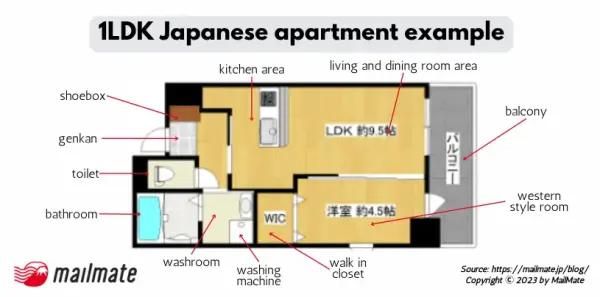
Common 1LDK Japanese floor plan
A 1LDK gives you the most living space of the four layouts above. Most 1LDK apartments have closet space and a separate bathroom, toilet, and sink area.
You may also see 1SLDK. This is a 1LDK apartment with an extra storage room.
Summary:
A proper one-bedroom apartment
Floor space: 25 to 40 square meters
Price range in central Tokyo: ¥120,000-¥250,000
Larger Japanese apartment layouts
Families and larger households often need more than one bedroom. Here is what the larger apartment layout terms mean.
City centers favor 1R and 1K apartments, since space is limited and costs are high. Rural areas favor 2LDK and 3LDK apartments instead, where space is easier to find and more affordable.
Parking also matters more outside major cities. Many rural apartments include a parking space, while city apartments often don't.
2LDK
A 2LDK apartment has two rooms, plus a living room, dining area, and kitchen. This layout suits couples, small families, or roommates who want separate bedrooms.
Summary:
Two rooms with a living room, dining area, and kitchen
Floor space: 40 to 60 square meters
Price range in central Tokyo: ¥180,000-¥300,000
3LDK and 4LDK
A 3LDK apartment has three rooms, and a 4LDK has four rooms. Both include a living room, dining area, and kitchen.
These layouts suit larger families who need more bedrooms or an extra office room.
Summary:
Three or four rooms with a living room, dining area, and kitchen
Floor space: 60 to 90+ square meters
Price range in central Tokyo: ¥250,000 and up
Why are Japanese apartments measured in tatami mats?
Many room sizes in Japan end in 帖 or 畳. These characters count the number of tatami mats in a room.
Tatami mats have a long history in Japanese interior design. Builders have long measured room size by the number of tatami mats that fit inside.

Examples of tatami mats measurements
The tatami mat count also decides the apartment layout terms you see. Real estate listings use these size cutoffs for the second room in a layout:
Second room type |
Room size in tatami mats |
Room size in square meters |
|---|---|---|
K (kitchen) |
Under 4.5 mats |
Under 6.12 square meters |
DK (dining kitchen) |
4.5 to 8 mats |
6.12 to 12.96 square meters |
LDK (living dining kitchen) |
Over 8 mats |
Over 12.96 square meters |
This is why a small kitchen area gets a K, while a larger kitchen and dining space earns a DK or an LDK.
One tatami mat measures about 1.62 square meters, or roughly 180 cm by 90 cm. This is the minimum size set by Japan's real estate advertising standards, so every listing you see uses this same measurement.
A standard bedroom in Japan is often listed as 6 tatami mats, or about 9.7 square meters. Use this as a quick mental reference when you compare room sizes.
Many Japanese apartments now use a Western style room with hardwood floors. Some apartment layouts still include a Japanese-style tatami room.
Japanese apartment vocabulary to know
Many Japanese floor plans will use abbreviations and words to showcase the different areas.
Common Japanese apartment layout terms and their meanings
There are other less common vocabulary such as UT for utility terrence, MB for meter box, and PS for pipe space. Here is a PDF vocabulary list that you should know if you are apartment hunting in Japan:
Japanese apartment vocabulary list to know (PDF)There are also keywords to know about when getting an apartment in Japan. Here is a list of them:
不動産会社 (fudousangaisha) - Real estate company
不動産屋 (fudousanya) - Real estate agent
借家人 (shakuyanin) - Tenant
家賃 (yachin) - Monthly rent
敷金 (shikikin) or 保証金 (hoshoukin) - Deposit. About 1-2 months’ rent
保証人 (hoshounin) - Guarantor. Someone who will cover your rent or damages in case you can not pay or if you leave Japan.
保証会社 (hoshougaisha)- Guarantor company
礼金 (reikin) - Key money. Gift money that is paid to the landlord
契約 (keiyaku) - Contract
更新料 (koshinryo) - Renewal fee. Leases are usually for 2 years, so there might be a renewal fee to continue living in that space.
解約金 (kaiyakukin) - Contract cancellation fee
保険 (hoken) - Insurance. The most common is 火災保険 (kasai hoken) or fire insurance
アパート (apaato) - A low-rise wooden apartment, usually 2 or 3 stories with no elevator
一戸建て (ikkodate) - Standalone house
マンション (manshon) - Condominium-type concrete apartments
シェアハウス (sheahausu) - Sharehouse
Frequently asked questions
What is a 1K apartment in Japan?
A 1K apartment has one room and a separate kitchen area. The kitchen area is usually small, with space for a counter and one burner. A 1K apartment is a common layout for singles and typically ranges from 20 to 25 square meters.
What is a Japanese apartment called?
There are two common Japanese apartment buildings: manshon and apaato. Apaato are typically low-rise wooden buildings, usually 2 or 3 stories with stairs and no elevator. Manshon are built with concrete and steel, with more floors and an elevator.
How do you read Japanese apartment listings?
Many Japanese apartment listings use terms such as 1R, 1K, DK, and LDK. These indicate the type of room layout that the apartment will have. R means the number of rooms, K means kitchen, D means dining, and L means living. Sometimes you will see S which means storage room.
What is the difference between 1LDK and 2LDK?
The main difference between them is the number of rooms. Both will have a living, dining, and kitchen area. But a 1LDK will have one bedroom, and a 2LDK will have two bedrooms.
What is the difference between 2LDK and 3LDK?
The main difference is the number of rooms. A 2LDK has two rooms, and a 3LDK has three rooms. Both include a living room, dining area, and kitchen, so a 3LDK simply gives you one more bedroom or office room.
In closing
Whether or not the apartment you want has free internet access, is pet friendly, has homeowner association fees, neighborhood association fees, or has a car parking space, will depend on what you are searching for. So be sure to tell your agent exactly what you are looking for.
Once you sign your lease, you still need to set up utilities, internet, and a way to manage your Japanese mail. MailMate can help with both.
Utility & Internet Set-Up
Utility & Internet Set-Up → covers everything you need to connect to local utilities. This includes set-up, contracting, and bill-pay support.
MailMate can also arrange a fiber optic internet hook-up and contract with a local provider. You do not need a Japanese bank account to use this service.
Virtual Mailbox & Bill Pay
Virtual Mailbox & Bill Pay → lets you access your Japanese mail from anywhere in the world. Every piece of mail comes with an English summary.
MailMate can also pay bills on your behalf. This saves you a trip to the local convenience store.
There are more steps to think about once you find your Japanese apartment, such as the moving out forms, address change, and Japanese companies. But don't worry, we have more articles to help you out.
👉 How to Submit a Moving-out Form in Japan: Tenshutsu Todoke
👉 A Guide to the Best Moving Companies in Japan in 2024
👉 How to Change Your Address in Japan: A Step-by-Step Guide
Spending too long figuring out your Japanese mail?
Virtual mail + translation services start at 3800 per month. 30-day money-back guarantee.