


Top Japanese Countryside Locations To Find Akiya Homes

Across rural Japan, from the forested mountains of Tohoku to the coastal towns of Shimane, millions of abandoned houses known as akiya (空き家) sit empty, creating an unusual opportunity for people who dream of rural life in Japan.
According to Japan's Ministry of Internal Affairs and Communications 2023 Housing and Land Statistics Survey, Japan had approximately 9.37 million vacant homes as of October 2023, roughly 13.8% of all housing stock in the country.
Many of these akiya are in Japan's countryside, listed through municipal akiya banks at prices far below anything comparable in Tokyo or Osaka.
What is the Japanese countryside called?
A Japanese countryside, called inaka, usually has images of small villages, remote islands, and small mountainside towns.
Think of it like any rural area, so inaka is great for anyone who loves nature.
What is an akiya?
Akiyas, in short, are abandoned vacant houses, usually in the Japanese countryside.
In general, they are:
Houses with low purchase prices (some rural akiya list for under ¥1 million, with a small number available at nominal cost through municipal programs)
Typically in rural or countryside areas
Often require some renovation or repairs
Houses often have a more Japanese traditional house plan
Why are there so many akiya in the Japanese countryside?
There’s an ongoing trend of younger generations in Japan moving to the city for better opportunities.
That trend, as well as the aging Japanese population, leaves plenty of houses in rural Japan abandoned and vacant.
Where to find an akiya in the Japanese countryside?
Like other real estate platforms, you can find akiyas all over Japan using akiya banks in Japanese and English.
Additionally, you can akiya in the Japanese countryside through word of mouth and searching the internet.
Where to find cheap houses for sale in Japan's countryside?
Japan's countryside covers a vast range of landscapes, climates, and lifestyles. Here is a brief orientation by region to help you match your ideal rural Japan experience to the right location.
Region |
Character |
Known for |
Tohoku (north Honshu) |
Forested mountains, deep valleys, hot springs |
Yamagata, Miyagi, Fukushima prefectures; rice farming, onsen towns |
Niigata / Hokuriku |
Heavy snowfall, Japan Sea coast, sake country |
Tsubame City metalwork, Noto Peninsula, clear rivers |
Nagano / Gifu |
Japanese Alps, "Roof of Japan," mountain villages |
Shirakawa-go (UNESCO), Matsumoto, surrounding mountains |
Shikoku |
Remote island, deep gorges, sacred pilgrimage routes |
Iya Valley, Shimanto River, 88-temple pilgrimage |
Shimane / Tottori |
Japan Sea coastline, sacred shrines, rural charm |
Tsuwano, Izumo Taisha, Mount Daisen |
Kagoshima / Kyushu south |
Volcanic scenery, coastal towns, warm climate |
Mount Aso, Yakushima Island, natural beauty |
1. Tsubame City, Niigata Prefecture

Aerial view of Tsubame City | Tsubame Kankou
Tsubame City, in central Niigata, is the hub for craftsmanship and manufacturing, especially for its metal processing.
In Tsubame, residents have a slower-paced lifestyle in the beautiful natural landscapes. Plus, with low crime rates and great educational resources, you can find about 23 nursery schools and 22 schools for all levels.
Tsubame City is actively supporting new residents, including foreign ones, with incentives for younger families and entrepreneurs.
The city has a great affordable housing market, which includes akiyas for about 10,000 yen.
Plus, because of its location, you can still access Tokyo City with a Shinkansen ride in just under 2 hours.
Tsubame City’s akiya search site (JP) can help you find and apply for an akiya directly from the city government.
2. Kanayama Town, Onuma District, Fukushima Prefecture

Oshi, Kaneyama, Onuma District, Fukushima Prefecture

The Fukushima Prefecture in Tohoku is an attractive relocation option for its natural beauty, accessibility, and diverse industries. Their economy is well-diversified, with a strong emphasis on service, retail, agriculture, and fisheries.
Because of its location, you can easily be in Tokyo or Sendai via Shinkansen in just a few hours.
Specifically looking at the Onuma District, their Kanayama Town has famous majestic mountains and hot springs, making must-go rural destinations if you drive nearby.
In a location like here, you’ll have plenty of space for a garden and all the DIYing you have to do if you want to make the space to your tastes and needs.
You can check Kanayama Town’s akiya platform for the latest information about their status. You'll find plenty of traditional houses here.
3. Okutama Town, Tokyo

Okutama, Tokyo | Tokyo de Kurasu
While there aren’t many akiya houses for sale in Tokyo city, if you go all the way west to Okutama, you’ll find a place with great rural charm and a couple of decent akiyas available. And with its location 2 hours away from central Tokyo, Okutama is one of the most sought-after Japanese countryside locations for akiyas.
Okutama is the place to get away from Tokyo’s city, and there are plenty of outdoor activities, from fishing and hiking to stargazing.
The town itself has extensive childcare support, educational subsidies, and medical assistance programs, making it a great place for families to raise their children. Plus, its proximity to Tokyo makes having a weekend city-modern life possible.
Okutama has great affordable housing, and its 0 Yen Vacant House Bank system makes buying a house in Japan cost almost nothing. It matches property and land owners with people who want to receive it practically for free.
But you have to be quick with it; these properties always seem to be already in the process of being contracted.
4. Shiojiri City, Nagano Prefecture

Shiojiri City, Otameshi Nagano
In central Japan, Nagano Prefecture is known for its mountainous landscape and natural beauty, earning it the title "Roof of Japan."
Specifically, Shiojiri City is surrounded by the Northern Alps, which makes living here a scenic beauty in Japan's countryside. But it’s about a 20-minute drive from downtown Matsumoto, a convenient place for shopping and other daily activities.
Shiojiri City has plenty of subsidy systems to encourage people to move there. One example is their "Various Agricultural Entry-Related Subsidy System," where new farms can have collection assistance grants. Additionally, it’ll provide subsidies for agricultural machinery and equipment expenses and rain protection equipment.
Even if you’re not a farmer, families with young children can use the Childcare Fee Reduction System, where the government will assist with school supplies, school lunch fees, and overall childcare support.
In terms of akiya, Nagano provides an akiya bank website (JP) for anyone interested in buying a property there. You can even do trial housing to see if living is for you.
5. Tsuwano Town, Shimane Prefecture

Tsuwano Town | Metropolis Japan
The Shimane Prefecture, on the western edge of Honshu along The Japan Sea, is renowned for its natural beauty, cultural heritage, and historical significance.
While its mountainous area receives snowfall, the coastal areas have a milder climate. Its economy thrives on agriculture, forestry, fishing, and tourism from the Izumo Taisha Shrine.
For any family and newcomers, Shimane has a strong support program from “Kokoro Passport” to provide discounts for families at participating stores and the “Tegoshite Shimane” portal as a resource for information on marriage, pregnancy, and child-rearing.
The Shimane Prefecture’s akiya bank program makes housing affordable, including in Tsuwano Town, known as “Little Kyoto of Sanin.” Its surrounding hills make this town feel tucked into the mountains. Many properties here are older and will require repairs, but that allows residents and owners to renovate the property to their heart content.
Plus, Shimane’s Longevity and Child-rearing Safety Housing Subsidy makes living here with family and the elderly much easier.
Post akiya purchase procedure.
So you just bought an akiya. But now what? Here are a couple of post akiya purchase procedures to be aware of:
Paying property tax
There are two key property-related taxes to be aware of when you purchase property in Japan as well as owning one:
The first is the real estate acquisition tax (不動産取得税, fudōsan shutoku zei), which is a one-time tax imposed when the property is officially purchased.
Then there’s the fixed asset tax (固定資産税, kotei shisan zei), which the property wonder pays every year.
One major factor that foreigners don’t consider is that you need to be in Japan or appoint someone as your tax representative to ensure these and other taxes are paid.
If taxes go unpaid, the government can place a tax lien on the property, impose surcharges, and ultimately pursue forced collection proceedings — which can put your ownership at risk. For non-residents, appointing a tax representative is not optional; it is a legal requirement in Japan.
Mailmate tax representative solution
If you need to appoint someone as your tax representative, make it MailMate.

When you make MailMate your tax representative, they will handle all the paperwork and payments for your fixed property tax and real estate acquisition taxes.
Renovation subsidies
Many Japanese municipalities offer renovation subsidies for akiya buyers who commit to living in the property.
These programs can cover 30–50% of renovation costs, with grants reaching ¥1–3 million depending on the municipality and project scope. Some depopulated areas offer enhanced grants of up to ¥5 million through their akiya bank programs.
Subsidies typically require the buyer to use the property as a primary residence for 3–5 years. Check the specific municipality's website or contact their akiya bank directly to confirm available programs before purchasing.
Setting up utilities
Buying a property in Japan can mean little to no renovation or a complete makeover.
Whatever your choice, you want to ensure that your property has running utilities such as water, gas, and electricity.
Since these utility companies are in Japan, you have to call them JST time and schedule someone to be at the property as needed.
Sounds like a hassle? Well, it no longer is.
Get a utility liaison.
One of MailMate’s property services is for them to set up your utilities for you. You don't have to make a phone call in Japanese to schedule anything.
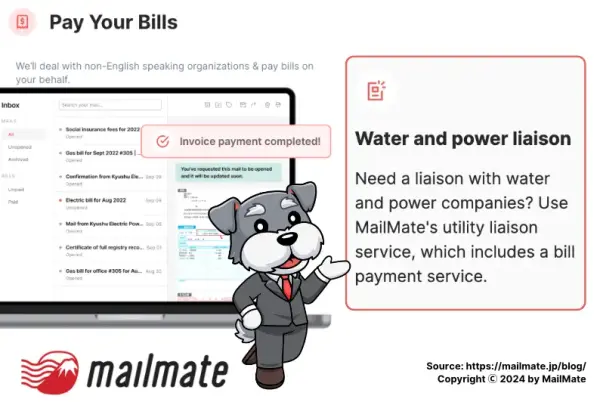
Plus, with MailMate, you can receive and view any utility bills and government notices on your MailMate dashboard.
All you have to do is click “Pay bill,” and your bill will be paid. Easy as that.
Important legal update for 2024 and beyond
In April 2024, Japan introduced mandatory inheritance registration (相続登記の義務化). Heirs who inherit property — including akiya — are now required to register the title transfer within three years, with penalties for non-compliance. Before purchasing any akiya, confirm that the property's ownership registry is current and that there are no unresolved inheritance issues. An estimated 30% or more of vacant houses have unclear ownership, and a judicial scrivener (司法書士, shihō-shoshi) can help navigate these situations.
Frequently asked questions
What is the Japanese countryside called?
The Japanese word for countryside is inaka (田舎). It refers broadly to any rural area outside major cities, from small farming villages and mountain towns to remote coastal communities and island settlements. Japan's countryside spans dramatically different landscapes — the snowy mountains of Tohoku, the deep gorges of Shikoku's Iya Valley, the Japan Sea coastline of Shimane, and the volcanic scenery of Kagoshima, among many others.
What is an akiya?
Akiya (空き家) means vacant or abandoned house in Japanese. Most akiya are properties left empty after the death of an elderly owner, often inherited by family members who live in cities and cannot maintain the property. As of October 2023, Japan had approximately 9.37 million akiya — about 13.8% of all residential properties in the country. Rural prefectures like Wakayama and Tokushima have vacancy rates exceeding 21%.
How much does an akiya cost in Japan?
Rural akiya typically list for between ¥2 million and ¥6 million (approximately $13,000–$40,000 USD). A small number are available at near-zero prices through municipal 0-yen programs like Okutama's Vacant House Bank. However, renovation costs are almost always significant — budget ¥1 million to ¥5 million or more on top of the purchase price. Some municipalities offer renovation subsidies covering 30–50% of costs, which can substantially reduce the total investment.
Can foreigners buy akiya in Japan?
Yes. Japan places no restrictions on property ownership by foreign nationals. Foreigners can buy akiya while on a tourist visa, and some transactions can be completed remotely using a power of attorney. However, buying property in Japan does not grant any visa or residency status. For non-resident owners, appointing a Japanese tax representative is a legal requirement for paying annual property taxes.
What is the mandatory inheritance registration law in Japan?
In April 2024, Japan introduced mandatory inheritance registration (相続登記の義務化), requiring heirs who inherit property to register the title transfer within three years. Failure to comply carries penalties. This law is particularly relevant for akiya buyers because an estimated 30% or more of vacant houses have unclear ownership due to unregistered inheritance transfers spanning multiple generations. Always confirm a property's ownership registry is current before purchasing.
Where is the best Japanese countryside for akiya?
The best Japanese countryside location for akiya depends on your priorities. Niigata (including Tsubame City) offers high connectivity to Tokyo by Shinkansen and strong municipal support for newcomers. Nagano and Gifu prefectures offer mountain scenery and proximity to ski resorts. Shimane and Tottori on the Japan Sea coast offer very low prices and rich cultural heritage. Fukushima's Tohoku region offers low costs, hot springs, and diversified local economy. Shikoku — particularly the Iya Valley area — offers dramatic scenery and deep rural character for those wanting true inaka life.
What are the ongoing costs of owning akiya in Japan?
The two key property taxes are the real estate acquisition tax (不動産取得税), a one-time payment when the property is purchased, and the fixed asset tax (固定資産税), which is paid annually. For non-residents, a Japanese tax representative must be appointed to handle these payments. Utility setup, insurance, and ongoing maintenance are additional costs to budget for. Some municipalities provide subsidized utility setup and maintenance support for new residents.
What is inaka life like?
Living in Japan's countryside (inaka) typically means slower pace, lower cost of living, and strong community ties. Public transport is limited in most rural areas, making a car essential. Average rent is roughly half of Tokyo rates, and many municipalities offer childcare subsidies, school support, and relocation incentives to attract younger families. The tradeoff is reduced access to urban amenities, English-language services, and international communities — factors that vary significantly by specific location.
In closing
So your Japanese countryside dream is an akiya away. Even if you are curious, look at what the Japan countryside has to discover.
Plus, many of Japan's rural areas have affordable options and local support programs, so moving there can be a breeze for anyone.
Spending too long figuring out your Japanese mail?
Virtual mail + translation services start at 3800 per month. 30-day money-back guarantee.