


Property Management Systems in Japan: A Comprehensive Guide

Property management systems, or PMSs, are vital in the hospitality industry.
This guide explores what PMS is, its features, benefits, and how to choose one for your minpaku, minshuku, or Airbnb property in Japan.
Quick answer: Top PMS options for Japan properties
If you want a side-by-side comparison before diving into the details, here it is:
PMS |
Best For |
Monthly Cost |
Key Feature |
Japan Support |
Cloudbeds |
Small to medium hotels, guesthouses |
¥15,000 to ¥40,000 |
Channel manager built-in |
Partial |
Aipass |
Business hotels, repeat guests |
Contact for pricing |
Group and long-stay reservations |
Full |
Little Hotelier |
Small properties, Airbnb hosts |
¥10,000 to ¥25,000 |
Simple setup, OTA sync |
Partial |
GLOVIA smart ホテル |
Large hotels, wedding venues |
Contact for pricing |
Event and banquet management |
Full |
BizSite N@FACE CLOUD |
Business hotels |
Contact for pricing |
Dynamic rate adjustment |
Full |
Note: Monthly costs are estimates based on publicly available pricing and may vary based on property size, number of rooms, and selected features. Contact each provider directly for an accurate quote.
For a full breakdown of features, implementation timelines, and how to choose the right system for your property type, continue reading below.
What a PMS doesn't handle: Japanese postal mail
One operational gap that most PMS platforms don't address for foreign property owners in Japan is Japanese government correspondence and postal mail. Tax notices, municipal notifications, and utility correspondence arrive in Japanese and require a registered physical address. None of the PMS tools above solve this problem.
This is where a service like MailMate fits into your property management stack. Rather than replacing your PMS, it handles the layer your PMS ignores:
Tool |
Category |
What It Handles |
Cloudbeds / Aipass / Little Hotelier |
PMS |
Reservations, guests, billing, housekeeping |
MailMate |
Virtual mail and office service |
Japanese postal mail, government notices, bilingual translation, registered business address |
For foreign property owners managing one or multiple listings in Japan, running both tools in parallel covers the two most common operational pain points: guest management and Japanese bureaucratic correspondence.
What is a property management system?
A property management system is a software platform that a wide range of establishments, including hotels, inns, and Airbnbs, utilize to manage tasks and enhance customer service.
Many property management systems can handle various actions, including but not limited to room reservations, guest check-in and check-out processes, room availability management, billing, and customer service.
Essential property management features for Japanese properties
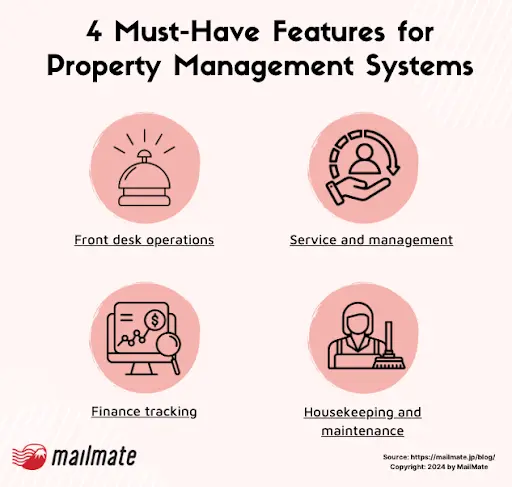
When evaluating PMS options for your Japanese property, certain features have proven indispensable for smooth operations, room management, and guest satisfaction. These core capabilities form the foundation of any effective property management strategy.
1. Front desk operations
An online property management system with front desk operation features combines managing reservations with front desk tasks to streamline the booking process (whether direct bookings or online bookings) and room tracking status.
Today's travelers expect efficiency and convenience throughout their stay experience.
Robust front desk management combines reservation management with guest services to create seamless experiences from booking to departure.
Modern front desk features include automated online check-in and check-out processes, QR code-based self-service options, and real-time room status tracking.
Many Japanese properties have found particular success with contactless solutions to check guests in and out and bypass traditional front desk interactions while still maintaining high service standards. The system should also support multiple languages, essential for serving Japan's diverse international visitor base.
For example, many travelers use self-service check-ins with QR codes or automatic check-outs instead of interacting with a front desk or filling out paperwork.
2. Advanced service and guest management
This feature includes customer service, facility management, maintaining guests' profiles, and managing your venues to ensure everything runs smoothly without scheduling conflicts.
Exceptional hospitality requires understanding and anticipating guest needs. Comprehensive service management features help properties deliver personalized experiences while maintaining operational efficiency across multiple areas of guest interaction.
This includes detailed guest profile management that tracks preferences, special requests, and stay histories.
The system should facilitate smooth coordination between departments, from housekeeping to concierge services, ensuring that guest requests are handled promptly and nothing falls through the cracks. For properties managing multiple locations, centralized guest data becomes particularly valuable for providing consistent service across all touchpoints.
3. Integrated financial management
A great property management system software helps with financial operations, from point-of-sale transactions for comprehensive accounting to automatic account verification for accurate and up-to-date data.
Key financial features include automated billing and invoicing, integration with Japanese accounting standards, and real-time revenue reporting.
The system should handle complex pricing structures, including seasonal rates and group discounts, while providing detailed analytics on revenue performance, occupancy trends, and profit margins. This data proves invaluable for strategic decision-making and identifying opportunities for revenue optimization and management.
4. Intelligent housekeeping and maintenance coordination
Housekeeping and maintenance are crucial to keep your property clean and well-managed. A property management system can help schedule and oversee cleanings of facilities and larger spaces.
Effective PMS solutions streamline these critical operational elements to ensure guest-ready spaces and prevent maintenance issues from impacting the guest experience.
Advanced housekeeping features include automated room status updates, maintenance request tracking, and integrated scheduling that accounts for checkout times, cleaning requirements, and maintenance needs.
Hotel property management systems should provide real-time visibility into room readiness, allowing front desk staff to make informed decisions about room assignments and guest accommodations.
For example, with certain property management systems, the cleaning management feature lets you schedule and track cleaning so rooms are ready for new guests.
What are the benefits of a property management system?
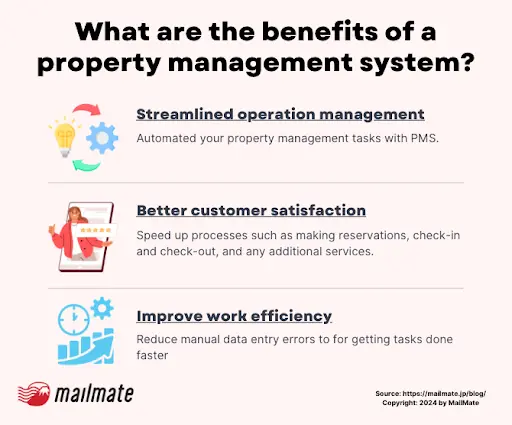
A property management system is one of the most impactful investments a property owner can make in the hospitality industry. Whether you manage a single minpaku, a portfolio of vacation rentals, or a full-service hotel, the right hotel property management system replaces scattered tools and manual processes with a single, unified software platform that handles everything from reservation management to payment processing.
Below are the core benefits properties across Japan report after adopting a hotel PMS.
1. Streamline operations across every department
The primary reason properties invest in a property management system PMS is to streamline operations that would otherwise consume hours of staff time every day. A cloud based hotel PMS connects front desk management, housekeeping, billing, and guest services into one interface, eliminating the need to jump between disconnected tools.
For hotel staff managing daily operations manually, this shift is immediate and measurable. Properties report reducing time spent on back office operations and repetitive tasks by 30 to 50% after implementation. That time moves toward guest experience improvements instead.
A modern cloud PMS also handles software updates automatically, meaning your team always works on the latest version without IT involvement or downtime.
2. Manage all reservations through a central reservation system
A hotel property management platform built around a central reservation system gives front desk staff a single, real-time view of every booking regardless of where it originated. Whether reservations come through travel agents, direct bookings via your booking engine, or third-party distribution channels like Airbnb and Booking.com, they all flow into the same management system.
Channel managers built into or integrated with your PMS sync room rates and availability across all platforms simultaneously. This eliminates double bookings, keeps room details accurate, and ensures that what guests see on any platform reflects your actual inventory in real time.
For properties that rely heavily on online booking, a connected online booking engine further increases direct bookings by allowing guests to reserve rooms directly through your website, bypassing OTA commission fees entirely.
3. Improve front desk management and guest services
Front desk management is where a cloud based hotel PMS delivers the most visible day-to-day improvement. Desk staff can check guests in and out faster, access complete guest profiles in seconds, and handle requests without switching between systems.
Modern hotel operations increasingly depend on online check in and check out capabilities. Guests can complete registration before arrival, receive digital keys or PIN codes for in room controls, and bypass the front desk entirely if they choose. For Japanese properties serving international visitors, this removes language barriers at arrival and makes unstaffed operations viable.
Front desk staff also benefit from desk management tools that provide real-time room status updates, so decisions about room assignments and upgrades are based on accurate, live data rather than manual tracking.
4. Strengthen revenue management and rate management
A property management system gives property owners the data infrastructure needed for effective revenue management. Rather than setting static room rates and hoping for the best, a cloud based PMS provides real-time visibility into occupancy trends, booking pace, and distribution channels performance.
Rate management features allow you to adjust pricing dynamically based on demand, seasonality, and competitor rates. For hotel operations in Japan's competitive short-term rental market, this capability directly impacts profitability. Properties that actively use PMS-driven revenue management tools consistently outperform those relying on manual rate setting.
Accounts receivable tracking and automated invoicing further strengthen financial control, reducing the risk of missed payments and billing errors that are common when managing room management across multiple listings manually.
5. Centralize guest data and build complete guest profiles
One of the most underused benefits of a hotel PMS is its ability to build and maintain complete guest profiles over time. Every stay, preference, special request, and communication history is stored in one place and accessible to desk staff at any point.
For property owners managing commercial properties or multiple vacation rentals, centralized guest data means a returning guest receives consistent, personalized service regardless of which property they book. This is not achievable when guest profiles live in separate spreadsheets or individual OTA dashboards.
Cloud based software makes this data accessible from any device, meaning a manager can review guest data and make operational decisions remotely without being on-site.
6. Integrate with third-party solutions through open APIs
A modern property management system PMS does not operate in isolation. Through open APIs and third party integrations, it connects with the tools your hotel already relies on: POS systems for restaurant and bar transactions, payment gateways for secure payment processing, accounting software for office operations, and channel managers for OTA distribution.
Third party products and third party solutions that integrate cleanly with your PMS create a connected operational stack where data flows automatically between systems. This removes the manual data entry that causes errors in payment processing, reservation management, and financial reporting.
For properties using globally recognized platforms, both Opera Cloud and Mews PMS offer extensive third party integrations designed for complex hotel operations, while lighter options like Little Hotelier and Aipass are better suited for smaller properties that need core functionality without enterprise complexity.
7. Replace on-premises software with scalable cloud infrastructure
Older on premises software requires local servers, manual software updates, and dedicated IT support. For most property owners in Japan, this is neither practical nor cost-effective.
Cloud based PMS platforms have replaced on-premises systems as the industry standard across the hotel industry because they offer automatic updates, remote access, lower upfront costs, and scalable pricing as your portfolio grows. Whether you manage a single guesthouse or a network of holiday parks and vacation rentals, a cloud pms scales with your business without requiring hardware investment.
For foreign operators managing properties in Japan remotely, the ability to access your entire management software stack from outside the country through a secure browser is not a convenience feature. It is an operational requirement.
How to choose a property management system
The Japanese hospitality market and hotel industry include diverse property types, each with unique operational requirements and guest expectations. Selecting the right PMS requires understanding these differences and matching system capabilities to your specific needs for third-party integrations and growth plans.
Property Type |
Essential Features |
Monthly Cost Range |
Implementation Time |
Small and Medium Properties |
Intuitive reservation management, straightforward billing processes, basic reporting capabilities, mobile access, cloud-based solutions |
¥5,000 to ¥20,000 |
2-4 weeks |
Business Hotels |
Corporate rate management, advanced CRM features, group booking management, detailed billing for expenses, loyalty program integration, and meeting room booking integration |
¥30,000 to ¥80,000 |
4-8 weeks |
Large Hotels and Resorts |
Multi-property management, advanced revenue optimization, spa and restaurant integration, event and banquet management, multiple user roles and permissions, extensive customization options |
Contact for pricing |
3-6 months |
We go into further detail below:
1. For small and medium-sized facilities
Whether you run an inn, guesthouse, small hotel, hostel, or Airbnb, an easy-to-use and cost-effective property management system software is designed to streamline your daily operations without any complexities.
This adaptability can provide a reassuringly simple solution for your property management needs, regardless of your establishment type.
Basic features such as reservation management and a simplified account are sufficient to keep things running.
If you're already using a PMS, add MailMate to your lineup to streamline your Japanese postal mail and translate its content into English.

The service offers centralized mail collection and management across multiple properties, eliminating the need for physical mail collection and distribution.

Automated workflow features allow you to create rules for sorting, forwarding, and storing important documents with minimal manual intervention.
Perhaps most valuable for international property operators, MailMate provides bilingual support for understanding Japanese government notices, utility correspondence, and other critical communications that impact your business operations.
2. For business hotels
Business hotels need features supporting repeat customers, managing corporate clients, and supporting their partnerships.
Business hotels in Japan can use two main options for their property management systems. Aipass (アイパス) helps make reservations for repeated guests, those with long-term consecutive stays, and even large group reservations based on their customers' past preferences and frequency of past stays.
There's also ビズサイト・ナフェイス CLOUD (BizSite N@FACE CLOUD), where you can use their services to adjust the room's rate based on the type and time of day, and adjust for demand and supply.
3. For larger-scale facilities
Larger hotel operations, commercial properties, and resorts with over 100 rooms need a robust property management system to handle complex operations such as managing staff, multiple guests' room details, and coordinating large-scale events.
Youcom's Hotel Manager Series is a highly customizable property management system software that integrates with all aspects of your operations. For properties that focus on managing events and banquets, then 宿OH!Pro is for you.
Finally, for hotels specializing in weddings and department banquets, GLOVIA smart ホテル can handle reservations, estimations, and payment management.
PMS vs. channel manager vs. CMS: What's the difference?
These three tools are consistently confused by first-time property operators in Japan. They serve distinct purposes and are not interchangeable.
Property Management System (PMS): The operational core of your property. Manages reservations, check-in and check-out, housekeeping schedules, billing, and guest profiles. Think of it as your property's internal operating system.
Channel Manager: Syncs your availability and pricing across multiple OTA platforms (Airbnb, Booking.com, Expedia) in real time. Its primary job is preventing double bookings. Many modern PMS platforms include a channel manager as a built-in feature or offer direct integration with one.
CMS (Content Management System): Manages your website content. This is where you edit your booking page text, photos, and descriptions. It has no connection to property operations or reservation management.
For most Japanese short-term rental operators, a PMS with a built-in channel manager is the most cost-efficient starting point. You get reservation management and OTA sync in a single platform, without paying separately for two tools.
Tool |
Primary Job |
Examples |
PMS |
Manage operations, guests, billing |
Cloudbeds, Aipass, Little Hotelier |
Channel Manager |
Sync availability across OTAs |
SiteMinder, Beds24, Smoobu |
CMS |
Manage website content |
WordPress, Wix, Squarespace |
Frequently asked questions
What is the difference between PMS and HMS?
PMS stands for property management system, while HMS stands for hotel management system. They are related but not identified, as both systems help manage and streamline their properties. Both systems help streamline the process of managing properties.
How long does PMS implementation typically take?
Implementation timelines vary significantly based on property size and complexity. Small properties can often complete basic implementations within 2-4 weeks, while large hotels may require 3-6 months for full deployment, including staff training and system optimization. The key is realistic timeline planning and adequate staff preparation.
What should I expect to pay for PMS in Japan?
Pricing varies widely based on property size and feature requirements. Small properties typically pay ¥5,000-20,000 monthly, business hotels range from ¥30,000-80,000 monthly, and enterprise solutions can exceed ¥100,000 monthly. Consider the total cost of ownership, including implementation, training, and ongoing support when evaluating options.
How do I ensure data security and compliance with Japanese regulations?
Choose PMS providers that specifically support Japanese data protection requirements and maintain local data storage options. Ensure the system provides detailed audit trails, secure guest data handling, and integration with Japanese accounting and tax reporting requirements. Regular security audits and staff training on data handling procedures are also essential.
In closing
Property management systems, especially in Japan, promote DX for hotels, hostels, inns, and Airbnb accommodations. Leveraging PMS technologies maximizes time and cost efficiency for your property.
Managing correspondence across multiple properties presents unique challenges in Japan's document-heavy business environment.
MailMate provides centralized mail management that integrates seamlessly with your existing PMS workflows to ensure important communications never get overlooked.
Spending too long figuring out your Japanese mail?
Virtual mail + translation services start at 3800 per month. 30-day money-back guarantee.